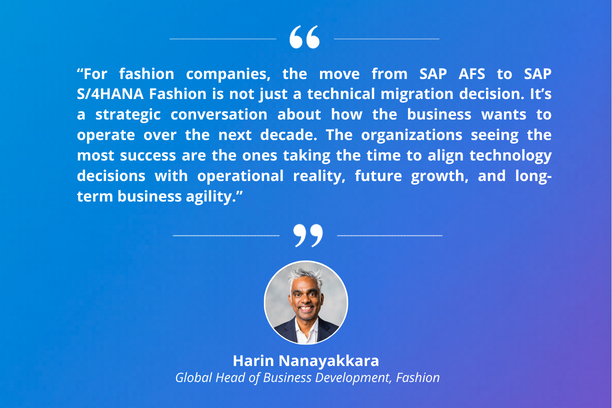

Explore the business, operational, and strategic realities fashion companies must evaluate before making the move.
For many fashion and consumer products companies, SAP AFS has been the backbone of the business for years. It has supported seasons, collections, wholesale orders, size and color complexity, allocations, deliveries, finance, reporting, and the everyday realities of running a fashion business. Over time, many AFS environments have become stable, customized, and well understood by the teams that rely on them.
So when the conversation turns to moving from SAP AFS or SAP FMS to SAP S/4HANA Fashion, the answer can sound obvious from a distance. Build a modern digital core. Move to the cloud. Prepare for AI. Reduce technical debt. Get ahead of maintenance timelines. Modernize the business. On paper, it can look like the obvious move.
But in the real world, the decision is rarely that simple. For most companies, this is not just a technology move. It is a business decision that touches operating models, processes, integrations, data, people, change management, and the future direction of the enterprise.
Is this really just about maintenance?

For many SAP AFS customers, maintenance timelines are what bring the conversation to the surface. Nobody wants to be forced into a major ERP decision because of support deadlines, extended maintenance fees, or uncertainty around future SAP timelines. But avoiding extended maintenance should not be the only reason to move.
The bigger question is whether the current platform can continue to support where the business is going. Can it support faster product cycles, new channels, better inventory visibility, cleaner data, stronger analytics, more automation, and the flexibility the business will need over the next decade? The stronger business case is usually built around future readiness, not only support deadlines.
Can RISE buy us more time?
RISE can also be part of the discussion. Some companies may look at moving an existing AFS or FMS environment to RISE as a way to buy time while they evaluate a broader S/4HANA Fashion transformation. In some cases, that may be a practical bridge. But it is important to be clear on what that solves and what it does not.
Moving to RISE and moving to SAP S/4HANA Fashion are not necessarily the same decision. RISE may help with cloud, infrastructure, commercial structure, or maintenance planning. But it does not remove the need to define the future ERP foundation. A bridge can be useful. It just should not be confused with the destination.

If the system works, do we really need to start over?
One of the biggest reasons this decision is nuanced is that many SAP AFS environments are not broken. In fact, many work quite well. They have been refined through years of continuous improvement. Custom developments were added for good reasons. Reports were built to support specific needs. Workarounds became operating procedures. Teams know the exceptions and how to keep the business moving.
The answer is not to dismiss everything that exists today. Some customizations may still represent real business value. But not everything should automatically move forward either. A system can be stable and still limit future growth. The opportunity is to separate what is strategic from what is simply historical.
That creates fair questions. If the system is stable, do we really need to start over? If our processes are mature, how much should we redesign? If our customizations support the business, what should we keep?
Is this an upgrade or a reimplementation?
Moving from SAP AFS to SAP S/4HANA Fashion is not a simple upgrade. For many organizations, it is closer to a reimplementation. That means the effort is not limited to converting a system. It requires decisions around process design, data migration, integrations, custom code, testing, reporting, training, and change management.
That naturally raises the big business questions: how long will this take, what will it cost, how much disruption should we expect, and how do we justify the ROI? Those questions need to be answered early and honestly.
The business case should not be built only around replacing an aging system. It should be tied to measurable improvements in operations, visibility, supportability, integration, speed, and long-term flexibility.
“Moving from SAP AFS to SAP S/4HANA Fashion is not a simple upgrade.”
For many organizations, it is closer to a reimplementation.
If We Are Mostly Wholesale, Is There Still Value?
For companies that are primarily wholesale, the move to a more vertically integrated platform may not feel obvious. If the business is not heavily direct-to-consumer, is there real value in moving to S/4HANA Fashion?
The answer depends on the business model and where the company is headed. Many wholesale businesses are no longer purely wholesale in the traditional sense. They may be expanding into direct-to-consumer channels, marketplaces, outlet stores, more sophisticated allocation models, or deeper collaboration with retail partners.
Even when wholesale remains the core business, the need for better visibility across product, inventory, orders, finance, and channels continues to grow. The roadmap should be based on where the business is going next, not only how it operates today.

What does the new SAP landscape mean for us?
Another reason this decision feels more complex is that SAP’s product landscape has changed significantly. The conversation is no longer limited to ERP functionality. Companies are now evaluating private cloud, public cloud, SAP BTP, data strategy, analytics, integration, automation, AI, and clean core principles.
That raises important questions. What belongs in the core ERP? What should be extended on BTP? How should data be structured for reporting and AI? What does clean core mean in a customized AFS or FMS environment? And if the company already moved from AFS to FMS, what are the realistic options for getting to S/4HANA Fashion?
These are not just technical questions. They have real implications for cost, timeline, flexibility, supportability, and long-term business value.
Can AI make this a simple lift and shift?

There is growing discussion around AI-enabled tools and accelerators that can help analyze configuration, custom code, and data. These tools can be valuable. They may accelerate discovery, provide insight into the current environment, and reduce effort in certain technical areas. But they do not make the decision simple.
A heavily customized AFS or FMS environment should not be blindly lifted and shifted into a new platform just because technology can help accelerate parts of the process. AI and automation can help with the journey. They should not replace business and technical judgment.
Start with the roadmap
For SAP AFS and SAP FMS customers, the most important step may not be launching a transformation immediately. The most important step is getting clear on the path forward. That means assessing the current environment, understanding business priorities, reviewing customizations, evaluating cloud options, identifying key risks, and building a realistic roadmap.
At EverBlue, this is where we believe we can help. We understand the SAP install base. We understand that every customization has a story behind it. And we understand that moving to SAP S/4HANA Fashion is not just about replacing a system. It is about preparing the business for what comes next.

So, is it an obvious move? Maybe. But not because the decision is simple. It becomes a strategic decision when the roadmap is clear, the business case is grounded, the risks are understood, and the future state is tied to where the company wants to go.