

A practical look at how organizations are modernizing data and analytics using SAP Datasphere and SAP Analytics Cloud to unify data, improve trust, and enable real-time, decision-ready insights.
Why Most Analytics Environments Break Down Over Time
In most organizations, analytics environments don’t fail because of a single bad decision. They degrade gradually.
A reporting tool gets added for a specific function. A data warehouse is extended to support a new business unit. Teams begin extracting data locally to move faster. Over time, what started as a structured system becomes a patchwork of pipelines, reports, and definitions that are only partially aligned.
The result is predictable:
- The same metric is calculated differently across teams
- Data refresh cycles vary depending on the source
- Business users lose confidence in what they’re seeing
- Analysts spend more time validating data than analyzing it
At that point, adding another dashboard or visualization layer doesn’t solve the problem. The issue sits deeper, in how data is structured, governed, and shared across the organization.
This is why the conversation has shifted from “better reporting” to data architecture and data products. Organizations are starting to treat data as a managed asset, not just an output.
What a “Data Fabric” Actually Means in Practice

The term “data fabric” gets used loosely, but in practical terms, it refers to an architectural approach where data is connected, governed, and reusable across systems without heavy duplication.
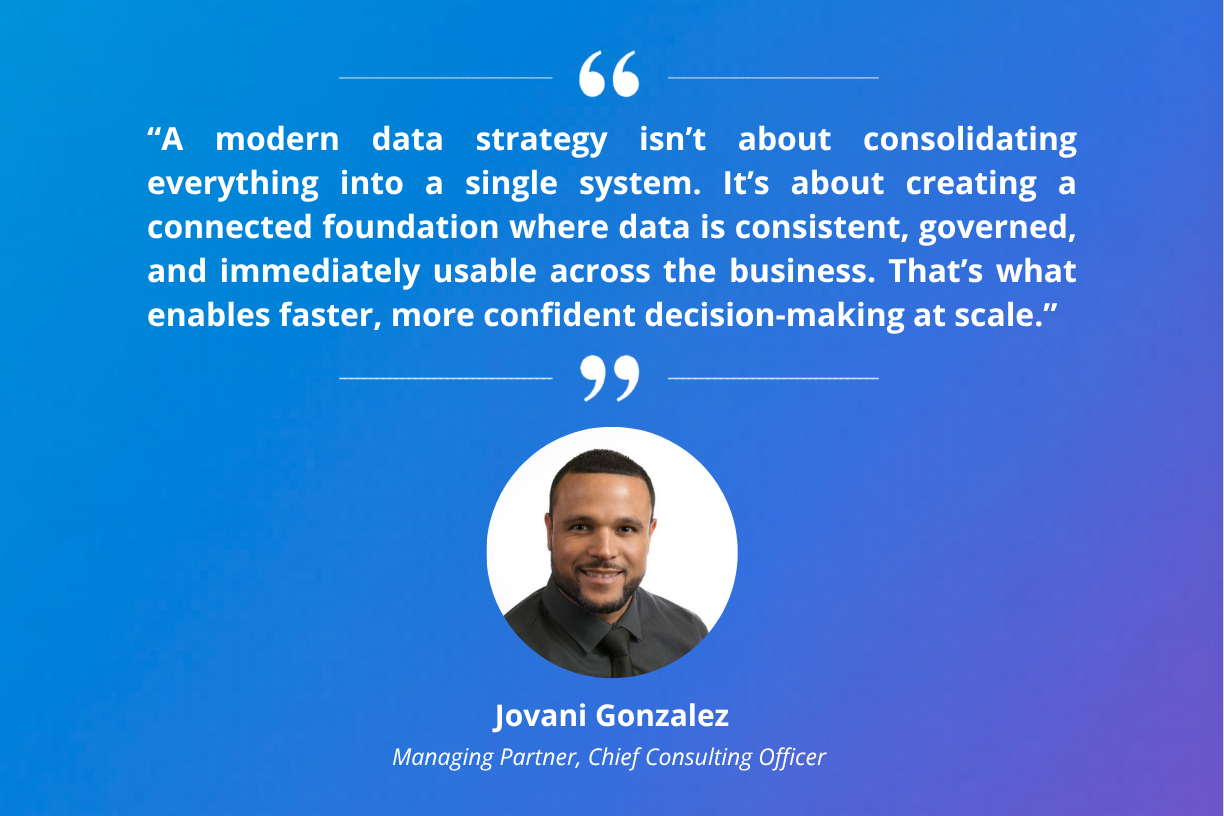
With platforms like SAP Datasphere, the goal is not to centralize all data physically, but to create a unified semantic layer that sits across distributed sources. This layer defines how business entities, such as customers, products, or revenue, are modeled and understood.
That distinction matters. Without a shared semantic layer, two teams can query the same underlying data and still produce different answers because the logic applied is inconsistent.
A well-designed semantic layer does three things:
- Standardizes business definitions so metrics are consistent across reports and use cases
- Abstracts technical complexity so business users interact with meaningful concepts rather than raw tables
- Enables reuse, allowing the same models to power dashboards, planning, and advanced analytics
When combined with SAP Analytics Cloud, this structure allows organizations to move beyond static reporting toward integrated analytics and planning, where insights can directly inform forecasts and operational decisions.
Real-Time Data Is Only Valuable If It’s Trusted
There is a strong push toward real-time analytics, particularly in industries like retail, where pricing, promotions, and inventory decisions are time-sensitive. However, real-time access introduces a tradeoff that many teams underestimate.

If data is updated continuously but lacks governance, consistency, or validation, the organization simply accelerates the spread of unreliable information.
To make real-time analytics useful, three conditions need to be met:
- Consistent modeling: Metrics must be defined once and reused everywhere
- Controlled data access: Users should see data appropriate to their role and context
- Clear lineage: It should be possible to trace how a number was calculated and where it originated
Without these elements, real-time systems tend to create more confusion than clarity.
This is why leading organizations focus on decision readiness, not just data availability. The question shifts from “Can we access the data?” to “Can we trust it enough to act on it immediately?”
Governance as an Enabler, Not a Constraint
Governance is often treated as a compliance exercise, something that slows down access to data. In reality, when designed properly, governance is what allows broader access without losing control.
In modern analytics environments, governance is embedded into the platform rather than managed externally. This includes:
- Defined ownership of data domains (e.g., finance owns financial metrics)
- Built-in policies for data access and usage
- Version control for data models and transformations
- Auditability for regulatory and internal compliance
This approach reduces the need for manual oversight while increasing confidence in the data being used.
The practical impact is that more users across the business can work with data directly, without relying on centralized teams to validate every output.
Why Many Transformations Underperform
A common pattern in analytics transformation programs is overemphasis on tooling and underinvestment in operating model design.
Organizations often implement new platforms but do not address:
- Who owns the data models
- How definitions are agreed upon and maintained
- How new use cases are prioritized and delivered
- How adoption is measured and reinforced
Without these elements, even well-implemented platforms struggle to gain traction.
Another issue is scope. Attempting to modernize the entire data landscape at once increases complexity and delays value realization. More effective programs focus on high-impact domains first, such as financial reporting or customer analytics, and expand from there.
How EverBlue Approaches Data & Analytics Transformation

At EverBlue, data and analytics transformation is treated as a sequenced program that connects business priorities with technical architecture.
Our work with SAP Datasphere and SAP Analytics Cloud focuses on a few core principles:
- Start with business-critical use cases where improved data access and trust can drive measurable outcomes
- Design the semantic layer early, ensuring that data definitions are aligned before scaling reporting
- Integrate SAP and non-SAP data strategically, avoiding unnecessary replication while maintaining performance
- Embed governance into the architecture, so it scales with adoption rather than becoming a bottleneck
- Enable both analytics and planning, allowing insights to feed directly into decision-making processes
This approach ensures that each phase of the program delivers tangible value while contributing to a broader, unified data foundation.
Let’s connect
If your organization is working through fragmented reporting, inconsistent metrics, or limited trust in data, EverBlue can help you design and implement a data and analytics foundation that supports real decision-making. Connect with our team to explore where to start.